
You are paying for weekly IB maths sessions, your child says “it’s going fine,” and yet the last test score barely moved. Sound familiar?
Many IB families reach this point. Tutoring is a real investment, and it is hard to judge progress when the subject is as demanding as IB Mathematics.
Quick answer: Your IB maths tutor is working if your student’s timed past-paper scores are rising, their mistakes are becoming less repetitive, they can explain solutions in their own words, and the tutor follows a clear plan tied to the IB syllabus. If none of these are happening after 6 to 8 weeks, something needs to change.
This guide from Teaching Academy shows you exactly what to look for.
What Does “Working” Mean in IB Maths?
Before judging your tutor, define success. IB Mathematics (Analysis and Approaches or Applications and Interpretation, at Standard or Higher Level) assesses students through:
- Paper 1 and Paper 2: timed written exams testing method, accuracy, and reasoning
- Paper 3 (HL only): extended problem-solving
- The Internal Assessment (IA): a mathematical exploration marked against set criteria
A good tutor supports all of these. “Working” does not just mean homework gets finished. It means the student is getting better at the skills the IB actually marks: showing method, applying concepts to unfamiliar problems, managing time, and communicating mathematically.
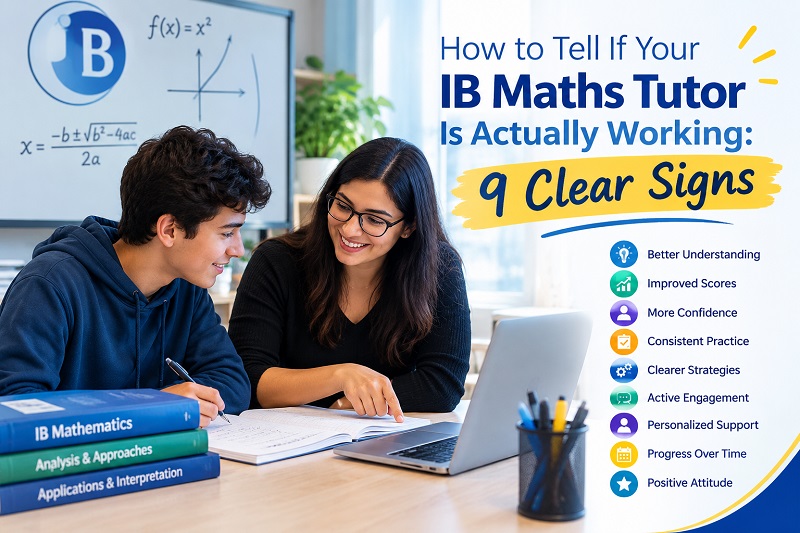
9 Signs Your IB Maths Tutor Is Working
1. They started with a diagnostic, not a textbook page
Effective tutors begin by finding out where the student stands. That might be a baseline test, a review of recent papers, or a topic-by-topic confidence check. If your tutor jumped straight into whatever the class is covering without assessing gaps, they are tutoring the syllabus, not your child.
2. There is a written plan with clear goals
You should be able to answer: What are we working on this month, and why? A strong tutor sets specific targets such as “raise Paper 1 accuracy on functions from 55% to 75% by half-term” and maps sessions to the IB syllabus, mock exam dates, and IA deadlines.
3. Timed past-paper scores are trending upward
This is the most reliable indicator. Track scores on timed IB-style papers every two to three weeks. Progress is rarely a straight line, but the trend over 6 to 8 weeks should point up. Watch for gains in both accuracy and speed, since many IB students know the maths but run out of time.
4. Your child can explain the “why”
Ask your student to teach you one problem they did this week. If they can explain why they chose a method and not just recite steps, learning is happening. A tutor who does the thinking for the student creates dependence, not understanding.
5. Mistakes are being analysed, not just corrected
Great tutors keep an error log, a running record of recurring mistakes such as sign errors, missing units, misread command terms, or weak algebra. Over time, the same errors should appear less often. If your child keeps making the same mistakes in month three as in month one, the tutor is not addressing root causes.
6. There is a feedback loop between sessions
Learning happens between sessions, too. Look for targeted practice tasks, quick check-ins on last week’s material, and written or recorded feedback. Sessions that start with “So, what did you want to go over today?” every time usually lack structure.
7. IA support is guiding, not writing
For the Mathematics IA, a working tutor helps your student choose a suitable topic, understand the assessment criteria, and improve their reflection and mathematical communication. They do not write or heavily edit the work. IB academic integrity rules matter, and ethical tutors respect them.
8. Confidence and independence are growing
You may notice your child starting problems without hesitation, attempting unfamiliar questions, or asking sharper questions in class. Growing independence is a strong sign. The best tutoring works toward a day when the student needs the tutor less.
9. You are kept informed
A professional tutor communicates. Expect regular progress summaries, honest feedback about weak areas, and clear next steps. Silence, or only vague praise like “he’s doing great,” is not enough.
6 Red Flags Your IB Maths Tutor May Not Be Working
- No measurable progress after 6 to 8 weeks of consistent sessions
- Homework is always “done together,” and the student cannot solve similar problems alone
- The tutor lacks IB-specific knowledge, such as mark schemes, command terms, or the AA/AI distinction
- Sessions feel like a homework-answer service rather than concept building
- Grades in school are dropping or staying flat despite regular tutoring
- Your child dreads or disengages from sessions
One red flag may be a temporary issue. Several together are a signal to act.
Working vs. Not Working: Quick Comparison
| What to Check | Tutor Is Working | Tutor Is Not Working |
|---|---|---|
| Starting point | Diagnostic and goal-setting | Jumps into random topics |
| Planning | Syllabus-aligned roadmap | Session-by-session improvisation |
| Scores | Upward trend on timed papers | Flat or unpredictable |
| Errors | Tracked and reduced | Repeated every week |
| Student role | Explains and attempts first | Watches the tutor solve |
| Communication | Regular, specific updates | Vague or absent |
| IA support | Guidance within IB rules | Over-editing or ghost-writing |
How Long Should You Wait to See Results?
Every student is different, but a reasonable guide is:
- 2 to 3 weeks: better organisation, clearer notes, more confidence in sessions
- 4 to 6 weeks: fewer repeated errors and improved topic tests
- 6 to 10 weeks: visible gains in timed paper scores and school results
Students with large gaps, such as weak algebra foundations before starting HL, may need longer. What matters is that the tutor can show you evidence of movement, even if the gains are gradual.
What to Do If Your Tutor Isn’t Working
Step 1: Gather evidence. Collect recent test scores, past-paper results, and teacher feedback.
Step 2: Talk to your child. Ask what feels helpful, confusing, or wasted about the sessions.
Step 3: Request a progress review. Ask the tutor for a summary of goals, progress, and next steps. A good tutor will welcome this.
Step 4: Adjust the approach. Ask for more timed practice, error analysis, or IA planning if those are missing.
Step 5: Switch if needed. If nothing improves after a transparent conversation, changing tutors is a sensible decision, especially with IB deadlines approaching.
7 Questions to Ask Your IB Maths Tutor Today
- What are my child’s three biggest weaknesses right now?
- How are you tracking progress between sessions?
- Which IB assessment objectives are we targeting this month?
- How do you handle Paper 1 and Paper 2 timing?
- How will you support the IA without crossing IB integrity lines?
- What should my child be doing on their own between sessions?
- When should we expect to see improvement in exam-style scores?
A confident, experienced tutor will answer these clearly and specifically.
How Teaching Academy Approaches IB Maths Tutoring
At Teaching Academy, we believe good tutoring should be visible, structured, and accountable. Our approach to online IB maths tutoring includes:
- Diagnostic-first onboarding to identify gaps before teaching begins
- Syllabus-aligned learning plans for IB Maths AA and AI, at SL and HL
- Regular timed practice built around real IB paper formats and mark schemes
- Error tracking so recurring mistakes are systematically eliminated
- Ethical IA guidance that develops the student’s own mathematical voice
- Clear progress updates for students and parents
Our goal is not just a better grade. It is a student who understands the mathematics and can perform under exam pressure.
Frequently Asked Questions
How do I know if my IB maths tutor is good?
A good IB maths tutor uses a diagnostic, follows a syllabus-aligned plan, tracks errors, assigns targeted practice, and communicates progress regularly. Most importantly, your child’s timed paper scores and confidence should improve over time.
How long does it take to see results from IB maths tutoring?
Most students show early improvements in confidence and organisation within 2 to 3 weeks. Measurable gains in test and past-paper scores typically appear within 6 to 10 weeks of consistent sessions.
Should my IB maths tutor do my child’s homework with them?
No. A tutor should guide, question, and explain, but the student should attempt problems first. If the tutor solves everything, your child may feel supported but will not be building the skills needed for exams.
Is it okay to change IB maths tutors?
Yes. If you have raised your concerns, given the tutor a fair chance, and still see no progress or engagement, switching is reasonable. Choose a tutor with specific IB experience and a transparent progress-tracking method.
How often should an IB maths student have tutoring sessions?
Most students benefit from one to two sessions per week, adjusted around exams, mocks, and IA deadlines. Consistency matters more than volume.
Can a tutor help with the IB Maths IA?
Yes, within IB rules. A tutor can help with topic selection, understanding the criteria, structuring the exploration, and improving mathematical communication, but the work must remain the student’s own.
Final Thoughts
Great tutoring is not a mystery. When it works, you can see it in the data, in your child’s confidence, and in how they approach problems. When it does not, the signs are just as clear if you know where to look.
If you are unsure where your child stands, Teaching Academy offers a free consultation and diagnostic conversation to help you find out. Whether you want to strengthen your current support or start fresh with a new online IB maths tutor, we are here to help your student succeed.