
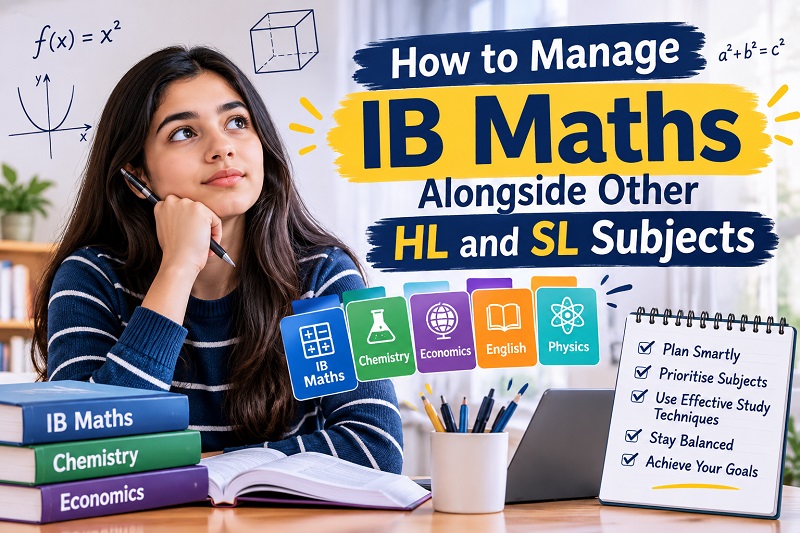
How Do You Manage IB Maths With Other Subjects?
To manage IB Maths alongside other HL and SL subjects, schedule short daily maths practice (45 to 60 minutes) instead of weekend cramming, rotate your subjects across the week, tackle past-paper questions by topic, plan Internal Assessment (IA) and Extended Essay deadlines backwards from submission dates, and get targeted help early when a topic stops making sense. Consistency beats intensity in the IB Diploma Programme.
If you are a Diploma student in Delhi NCR and feel that maths is eating into every other subject, this guide is for you. At Teaching Academy, our IB Maths Tutor in Gurgaon works with students every day who face exactly this problem, and the good news is that it is fixable with the right system.
Why Does IB Maths Feel So Demanding?
IB Maths is cumulative. Unlike a subject where you can revise one chapter in isolation, each maths topic builds on earlier ones. Calculus relies on functions, statistics relies on algebra, and vectors rely on trigonometry. If one foundation slips, the next three topics wobble.
There is also the sheer variety of demand. You need conceptual understanding, procedural fluency, calculator skills, written reasoning and, in Paper 3 for HL, extended problem solving. Add the Internal Assessment (the Mathematical Exploration), and maths becomes a year-round commitment rather than a pre-exam sprint.
When you combine this with three or four other subjects, Theory of Knowledge (TOK), the Extended Essay (EE) and CAS, time pressure is natural. Managing it well is a skill, and it can be learned.
Step 1: Know Exactly What Your Maths Course Demands
Before planning anything, be clear about your course. IB Maths comes in two pathways:
- Analysis and Approaches (AA): more algebraic, proof-oriented and suited to students heading toward engineering, physics, maths or economics.
- Applications and Interpretation (AI): more data, modelling and technology-focused, suited to business, social sciences and design.
Each is offered at Standard Level (SL) and Higher Level (HL). HL carries roughly 240 teaching hours against 150 for SL, so an HL Maths student should expect a noticeably heavier weekly load. If you take Maths HL plus one or two other HL subjects, you must plan more deliberately than a student with a mix of SL subjects.
A quick audit helps: list every subject, mark HL or SL, note the assessment components, and highlight the heaviest deadlines. This one-page overview becomes your planning map.
Step 2: Build a Weekly Timetable That Rotates Subjects
The most common mistake is studying subjects in long blocks (all of Sunday on maths, then nothing for four days). Because maths rewards frequent retrieval, spread it out.
A simple rotation for a student with Maths HL, two other HL subjects and three SL subjects might look like this:
- Monday to Friday: 45 to 60 minutes of maths daily, in a fixed slot, ideally when your energy is highest.
- Alongside maths: one or two other subjects per evening, 60 to 75 minutes each, rotating so every subject appears at least twice a week.
- Saturday: one longer session for past-paper questions or IA work, plus a weekly review.
- Sunday: light revision, planning the week ahead and genuine rest.
The point is not the exact numbers but the pattern: short, frequent, predictable. Students who place maths in the same slot each day tend to build the habit quickly, which reduces the mental effort of getting started.
Step 3: Use the Three-Layer Method for Every Maths Topic
Maths study fails when students only read solutions and feel they have understood. Try this three-layer approach instead:
- Learn: work through a concept with notes or a class example. Write the idea in your own words.
- Practise: attempt 8 to 10 varied questions without looking at the solution. Mark yourself honestly.
- Retrieve: return to the topic after two days, then a week, then a month, with three to five mixed questions.
This spaced retrieval is far more efficient than rereading. It also means you are never starting from zero before exams, which frees time for other subjects.
Keep an error log: a simple notebook listing each mistake, why it happened (concept, careless, calculator, time) and the fix. Reviewing this log for 15 minutes a week often lifts marks faster than another full chapter of practice.
Step 4: Find Overlaps Between Maths and Your Other Subjects
IB subjects are not isolated. Smart students use overlap to save time:
- Physics and Chemistry: graphs, rates of change, logarithms, vectors and error analysis all appear in both maths and science. Practising them in one context strengthens the other.
- Economics and Business Management: elasticity, optimisation, statistics and data interpretation reinforce maths topics, especially in AI.
- Computer Science: logic, functions and sequences connect directly to algebra and discrete maths.
- Biology and Geography: statistical tests, correlation and data handling support the AI course and the science IAs.
When you notice these links, mention them in your notes. It turns separate workloads into reinforcing ones.
Step 5: Plan IA, EE and TOK Deadlines Backwards
The Mathematical Exploration is only one of several long-term pieces. Combined with other IAs, the Extended Essay and TOK, deadlines can collide, especially in the first term of Year 2.
Work backwards from each submission date:
- Mark all final deadlines on one calendar, including school internal deadlines, which are often earlier than official ones.
- Break each piece into stages: topic choice, research, draft, feedback, final edit.
- Assign each stage a week, and avoid placing two major drafts in the same week.
- Choose your maths IA topic early. A topic you find genuinely interesting, with accessible mathematics and personal engagement, saves enormous stress later.
A good rule is to aim to finish internal assessments at least two weeks before the school deadline. That buffer absorbs illness, tech issues and unexpected tests.
Step 6: Use Past Papers Strategically, Not Just at the End
Many students leave past papers for the final two months. A better approach is to use them from the middle of Year 1.
- By topic first: after finishing a unit, solve official-style questions on that topic only.
- By paper second: from about six months before the exams, attempt full timed papers under exam conditions.
- Mark with the markscheme: learn how method marks, accuracy marks and follow-through marks work. Showing clear working can earn marks even when the final answer is wrong.
- Practise calculator use: know your graphing calculator’s functions well, such as solving equations, statistics menus and numerical integration.
This staged approach lets you balance maths with other subjects, because you are not suddenly adding a huge new workload near the exams.
Step 7: Protect Sleep, Energy and Mental Health
Time management is not only about hours; it is about energy. A tired student takes twice as long to solve the same problem.
- Sleep seven to eight hours. Memory consolidation, which matters for formulas and methods, happens during sleep.
- Take 5 to 10 minute breaks every 50 minutes of focused study.
- Keep one screen-free evening or half-day each week.
- Maintain some physical activity, even a 20-minute walk.
- Talk to your teachers, coordinator or a counsellor if the workload feels overwhelming. Asking early is a strength, not a weakness.
CAS is meant to support balance, so use it well rather than treating it as another box to tick.
When Should You Get an IB Maths Tutor in Gurgaon?
Self-study and school lessons work for many students, but extra support makes sense in specific situations:
- You repeatedly score below your target in topic tests despite studying.
- You understand lessons in class but cannot solve unfamiliar problems.
- Your maths IA topic is unclear or lacks mathematical depth.
- You are spending so much time on maths that other subjects are suffering.
- You are aiming for a 6 or 7 and need exam technique, not just content.
A skilled IB Maths Tutor in Gurgaon can diagnose weak areas quickly, build a personalised revision plan, and teach the examiner-focused methods that classroom time rarely covers. Because the tutor handles targeted gap-filling, you reclaim hours that can go into your other HL and SL subjects.
At Teaching Academy, our approach is built around the IB Diploma student’s reality: limited time, high expectations and several demanding subjects at once. Our IB Maths tutoring covers AA and AI at both SL and HL, with support for Internal Assessment, topic-wise practice, past-paper strategy and exam preparation. Sessions are structured around your school’s pace and your own targets, so maths becomes manageable rather than overwhelming.
Frequently Asked Questions
How many hours a week should I study IB Maths?
Most HL students do well with 6 to 8 hours per week, including class time, and SL students with 4 to 5 hours. Exact needs vary by your current level and target grade.
Is IB Maths HL harder than other HL subjects?
Many students find it among the most demanding because of its cumulative content and abstract reasoning. However, difficulty depends on your strengths. Students who practise consistently usually find it very manageable.
Can I take Maths HL with Physics HL and Chemistry HL?
Yes, and many students do, particularly those heading toward engineering or medicine-related paths. It requires strong planning and early support, because the combined workload is heavy.
When should I start preparing for the Maths IA?
Begin exploring topics by the end of Year 1 or the start of Year 2, and finalise your idea early. This leaves time for research, drafting and feedback.
Is an IB Maths tutor in Gurgaon worth it?
A tutor is most valuable when you have specific gaps, need IA guidance or want to improve exam technique. Targeted support often saves time overall, which helps you balance other subjects.
What is the best way to revise IB Maths quickly?
Use topic-wise past-paper questions, maintain an error log, and revisit weak topics using spaced repetition. Avoid passively rereading notes.
Final Thoughts
Managing IB Maths alongside other HL and SL subjects comes down to rhythm, not heroics. Study maths a little every day, rotate other subjects sensibly, plan long-term assessments backwards, practise past papers in stages, and protect your sleep. When a topic or the IA feels stuck, get help early rather than waiting for the exams.
If you are looking for an IB Maths Tutor in Gurgaon who understands the pressures of the Diploma Programme, Teaching Academy is here to help you build a clear plan, strengthen your concepts and approach your exams with confidence.