
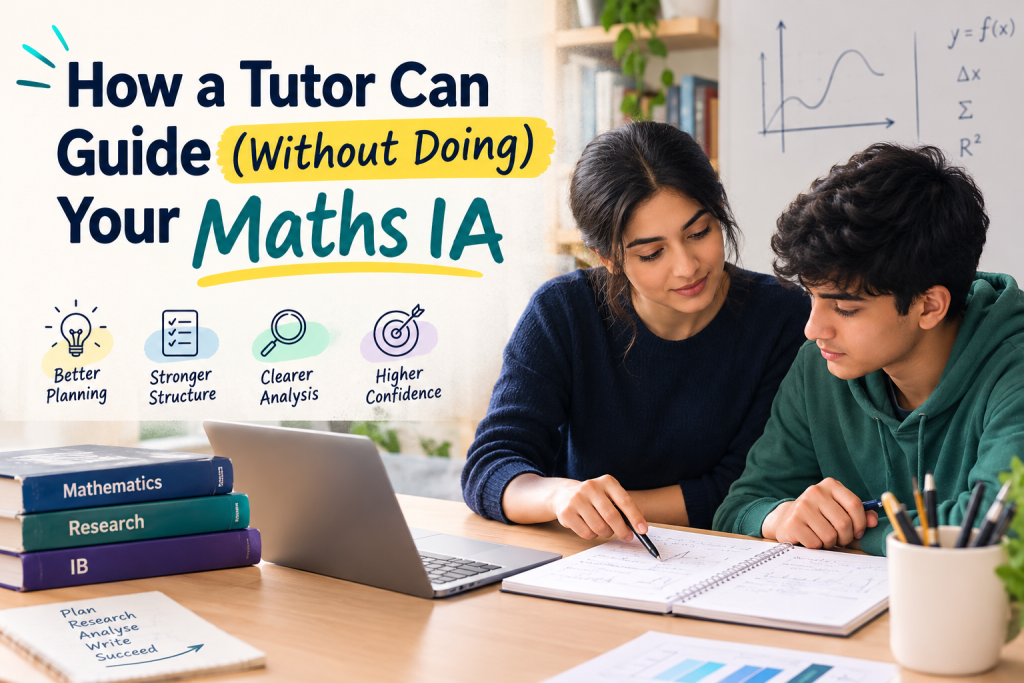
What Is the IB Maths IA, and Why Does It Matter?
The Mathematics Internal Assessment is a written exploration, typically 12 to 20 pages, in which you investigate a mathematical idea of your choice. It is marked by your teacher and moderated by the IB against five criteria:
- Presentation: is the work organised and coherent?
- Mathematical communication: are notation, terminology, graphs and diagrams used correctly?
- Personal engagement: does the exploration show your own thinking and interest?
- Reflection: do you critically evaluate your results, methods and limitations?
- Use of mathematics: is the mathematics relevant, accurate and at the right level for the course?
Because the IA carries a fifth of your grade, many students in Delhi NCR look for an IB maths tutor in Delhi and Gurugram well before their final exams. But the IA is unlike a past paper. There is no single right answer, which is exactly why support must be handled carefully.
Guiding vs. Doing: Where Is the Line?
The IB’s academic integrity policy expects the final submission to be your own work, with any sources properly acknowledged. The simplest way to understand the boundary is to ask: who generated the idea, the maths and the words?
| Ethical guidance (the tutor helps you think) | Misconduct (the tutor does the work) |
|---|---|
| Explaining a concept you don’t understand, such as integration by parts or hypothesis testing | Solving the IA’s central calculations for you |
| Asking questions that help you narrow a broad topic | Handing you a ready-made topic and research question |
| Giving feedback on a draft, such as “your conclusion doesn’t link to your aim” | Rewriting paragraphs or sections in their own words |
| Pointing out an error exists and asking you to find it | Correcting the error and giving you the fixed working |
| Teaching you how to use Desmos, GeoGebra or Excel | Building the model, graphs or code for you |
| Suggesting reliable resources to read | Giving you a completed or recycled IA to adapt |
A tutor who respects this line protects your grade and your integrity. IB moderators and schools use plagiarism-detection tools and can spot work that does not match a student’s voice or ability. A flagged IA can lead to a zero.
How a Tutor Guides You at Each Stage of Your Maths IA
1. Finding a topic that is genuinely yours
Most students begin with “I don’t know what to write about.” A skilled tutor won’t hand you a list of titles to copy. Instead, they explore your interests: cricket analytics, stock market patterns, architecture, music, climate data, medicine or gaming.
The tutor then asks questions such as:
- What do you find curious or frustrating about this topic?
- Where could mathematics explain or predict something?
- Is the level of maths appropriate for AA or AI, HL or SL?
This conversation turns a vague interest into a focused idea, while the decision stays with you.
2. Shaping the research question
A weak research question such as “How is calculus used in real life?” is too broad. A stronger one might be “How can differential equations model the cooling rate of tea at different temperatures?” A tutor helps you test whether a question is specific, measurable and mathematically rich, then lets you rewrite it yourself.
3. Building the mathematical understanding
This is where an IB maths tutor adds the most value. If your chosen topic needs Fourier series, Markov chains, chi-squared tests or optimisation, your tutor can teach those tools the same way they would teach any syllabus topic. Understanding the mathematics is fully legitimate support. What you do with that understanding, such as the calculations, interpretation and write-up, must be yours.
4. Planning the structure
A tutor can show you what a clear IA looks like: introduction and rationale, aim, method, analysis, evaluation and conclusion. They can explain how to use headings, how to present data and how to keep the exploration focused. The structure is a framework, and the content you place inside it is your responsibility.
5. Reviewing drafts with feedback
Feedback is the most valuable and most misunderstood part of tutoring. Good feedback is specific and criteria-linked, for example:
- “Your notation switches between x and t in section 3. Check consistency.”
- “You calculated the mean but did not interpret what it means for your question.”
- “Where is your reflection on the limitations of the data?”
The tutor flags issues. You fix them. This keeps the voice, reasoning and ownership in your hands.
6. Final checks against the criteria
Before submission, a tutor can help you review your IA against the five assessment criteria, check referencing and bibliography format, and make sure every graph and equation is labelled. This is quality control, not content creation.
What a Tutor Should Never Do
If an IB maths tutor in Delhi, Gurugram or anywhere else offers any of the following, walk away:
- Selling or sharing completed IAs or “model answers” to submit
- Guaranteeing a 7 or a specific score
- Writing sections of your exploration
- Running your calculations or code and giving you the output
- Reusing the same topic across multiple students
These promises may feel tempting under deadline pressure, but they put your IB diploma at risk.
Why the Right Guidance Raises Your Score
Students who work with a tutor ethically often see improvement in the criteria that matter most:
- Use of mathematics improves because difficult concepts become clear.
- Communication improves because feedback exposes unclear notation and gaps in reasoning.
- Personal engagement improves because the tutor encourages you to explain why you care about the topic.
- Reflection improves because you are asked to critique your own results rather than simply report them.
In short, a tutor makes you a better mathematician and writer, and the IA reflects that growth.
A Sample IA Timeline for Delhi NCR Students
Schools in Delhi and Gurugram usually set IA deadlines in the first half of Grade 12, though dates vary by school. Here is a realistic plan:
| Timeframe | Goal |
|---|---|
| Months 1 to 2 | Explore interests, shortlist ideas, finalise topic and research question |
| Months 2 to 3 | Learn the required mathematics, gather data, run first analysis |
| Months 3 to 4 | Write the first full draft |
| Month 5 | Receive feedback, improve analysis and reflection |
| Month 6 | Final proofreading, referencing and criteria check |
Starting early lets you work with your school teacher and tutor without rushing, which also lowers the temptation to take shortcuts.
How to Choose an IB Maths Tutor in Delhi and Gurugram for Your IA
When comparing tutors, ask:
- Do they have real IB experience? Look for familiarity with the AA and AI syllabi, the IA criteria and exam format.
- Do they explain their ethics policy? A trustworthy tutor will tell you upfront what they will and won’t do.
- Is the guidance personalised? Your topic should never match another student’s.
- Can they teach online and in person? Flexibility matters for students across South Delhi, Gurugram, Noida and beyond.
- Do they focus on understanding? The goal is for you to be able to defend your IA confidently if your teacher asks questions about it.
How Teaching Academy Supports Your Maths IA
At Teaching Academy, our approach as an IB maths tutor in Delhi and Gurugram is built on one principle: you do the work, and we help you do it better. Our tutors:
- Help you discover a topic that matches your interests and course level
- Teach the advanced concepts your exploration needs
- Give structured, criteria-based feedback on every draft
- Train you in tools like Desmos, GeoGebra and Excel
- Keep your work original, ethical and compliant with IB academic integrity rules
Whether you prefer one-to-one sessions at home or online classes from anywhere in Delhi NCR, we adapt to your school’s timeline and your learning pace.
Frequently Asked Questions
Can a tutor write my IB Maths IA?
No. The IB requires the IA to be your own work. A tutor may explain concepts and give feedback, but writing or solving any part of the IA for you is academic misconduct and can result in penalties.
How early should I hire an IB maths tutor for my IA?
Ideally 4 to 6 months before your school’s submission deadline. This gives you time to choose a topic, learn the mathematics and revise multiple drafts.
Is IA tutoring different from regular IB maths tutoring?
Yes. Regular tutoring focuses on syllabus topics and exam practice. IA tutoring focuses on topic selection, mathematical exploration, structure, reflection and meeting the assessment criteria.
Can a tutor check my IA for mistakes?
A tutor can point out where errors or weaknesses exist and explain why, but you should make the corrections yourself.
Do you offer IB maths IA guidance online in Delhi and Gurugram?
Yes. Teaching Academy offers both online and in-person guidance for students across Delhi, Gurugram and the wider NCR.
What is a good length for a Maths IA?
Most strong IAs are around 12 to 20 pages. Quality, focus and depth of mathematics matter far more than page count.
Final Thoughts
Your Maths IA is one of the few parts of the IB where you get to explore mathematics on your own terms. The right tutor will not take that opportunity away from you. They will sharpen your questions, strengthen your understanding and push you to communicate your ideas clearly, so that the finished IA is something you can be proud of and fully explain.
If you are looking for an IB maths tutor in Delhi and Gurugram who values guidance over shortcuts, Teaching Academy is here to help.