
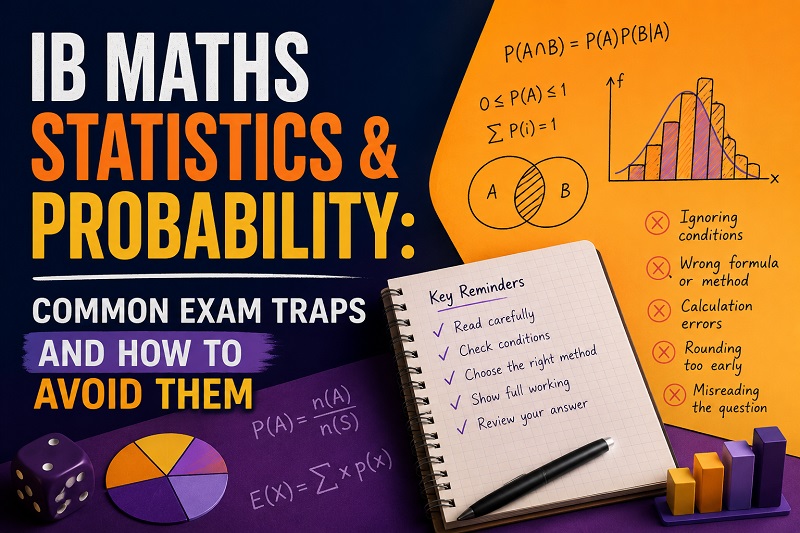
Statistics and Probability is one of the highest-scoring topics in the IB Maths syllabus — if you know how to avoid the traps examiners love to set. Every year, thousands of Applications and Interpretation (AI) and Analysis and Approaches (AA) students lose easy marks not because they don’t understand the concepts, but because they fall into predictable, avoidable errors under exam pressure.
This guide breaks down the most common mistakes IB students make in Statistics and Probability, explains why they happen, and shows you exactly how to avoid them. Whether you’re self-studying or working with an IB Maths tutor, understanding these traps is one of the fastest ways to move from a 5 to a 7.
Why Statistics & Probability Trips Up So Many IB Students
Unlike calculus or algebra, where a wrong answer is usually obvious, Statistics and Probability questions often look simple but hide conceptual traps in the wording. Examiners deliberately phrase questions to test whether you truly understand concepts like conditional probability, independence, and distribution assumptions — not just whether you can plug numbers into a calculator.
The result? Students who are otherwise strong in maths lose marks on questions they “should” have gotten right. Below are the traps that show up most consistently in past papers, along with practical fixes.
Trap 1: Confusing “And” with “Or” in Probability
One of the most common errors is misapplying the addition and multiplication rules.
- P(A and B) usually means multiplication (for independent events): P(A) × P(B)
- P(A or B) usually means addition, with an adjustment for overlap: P(A) + P(B) − P(A and B)
Students frequently mix these up, especially when a question is worded in a roundabout way (“at least one of…”, “neither…nor…”).
How to avoid it: Before doing any calculation, rewrite the question in your own words as a probability statement (e.g., “P(rains today OR rains tomorrow)”). This forces you to identify whether you’re dealing with a union or an intersection before you touch a formula.
Trap 2: Ignoring Independence Conditions
Many students assume two events are independent when they are not — or vice versa. This is especially common in tree diagram and conditional probability questions involving “without replacement” scenarios.
Example pitfall: Drawing two cards from a deck “without replacement” changes the probability of the second draw. Students who don’t adjust the denominator lose marks even if their method is otherwise correct.
How to avoid it: Always check the wording for “with replacement” vs “without replacement,” and for phrases like “given that,” which signal conditional probability. If the problem explicitly states or implies dependence, your tree diagram branches must reflect changing probabilities at each stage.
Trap 3: Misreading Conditional Probability Notation
P(A|B) is not the same as P(B|A) — but under exam stress, students frequently calculate the wrong one. This is one of the single biggest mark-losers in IB Statistics.
How to avoid it: Say the notation out loud in words: P(A|B) means “the probability of A, given that B has already happened.” Always identify which event is the “given” condition before setting up your fraction. When working with a two-way table, this means identifying the correct restricted sample space (the correct row or column) before dividing.
Trap 4: Using the Wrong Distribution
The IB syllabus includes binomial, normal, and Poisson distributions (depending on your course), and a huge number of marks are lost simply from choosing the wrong one.
Common confusion points:
- Using a binomial distribution when the situation actually describes a normal distribution (or vice versa)
- Forgetting that binomial distributions require a fixed number of trials and only two outcomes
- Applying continuous distribution logic (like normal) to discrete data
How to avoid it: Before touching your GDC (graphic display calculator), ask three questions:
- Is the data discrete or continuous?
- Is there a fixed number of trials with two outcomes (success/failure)?
- Does the question give a mean and standard deviation, suggesting a normal distribution?
Answering these correctly takes 10 seconds and can save an entire question.
Trap 5: Calculator Errors (Especially in AI courses)
Because IB Applications and Interpretation heavily rewards calculator fluency, many lost marks aren’t conceptual at all — they’re technical. Common calculator mistakes include:
- Entering the wrong parameters into
Binomial CDorNormal CDfunctions - Confusing upper and lower bounds in normal distribution calculations
- Forgetting to switch between PDF and CDF functions
- Rounding intermediate values instead of carrying full precision through to the final answer
How to avoid it: Practice your calculator’s statistics menu until it’s second nature — not just the day before the exam. Always write down the calculator command you used (e.g., normalcdf(lower, upper, mean, sd)) as working, since IB mark schemes often award method marks even if the final numerical answer is slightly off.
Trap 6: Poor Use of GDC Output in Written Answers
Even when students get the correct answer from their calculator, they often lose marks because they don’t show enough working. IB examiners require clear communication of method, not just a final number.
How to avoid it: Follow the “three-line rule”: state what you’re calculating, show the calculator command or formula used, then state the final answer with correct units and appropriate rounding (usually 3 significant figures unless told otherwise).
Trap 7: Misinterpreting Two-Way Tables and Venn Diagrams
Two-way tables and Venn diagrams are IB favourites because they test multiple skills at once. Common errors include:
- Reading rows instead of columns (or vice versa) when calculating conditional probability
- Forgetting to subtract the overlap region in Venn diagram union calculations
- Mislabeling regions when translating word problems into diagrams
How to avoid it: Practice converting written scenarios into diagrams first, before attempting any calculation. A correctly labeled diagram often makes the calculation almost automatic — and it also earns method marks even if your final arithmetic slips.
Trap 8: Sampling and Bias Questions (AI Course Specific)
Applications and Interpretation students are frequently tested on sampling methods (stratified, systematic, random, quota) and asked to critique the validity of a study. Many students describe the method correctly but fail to explain why it introduces bias or improves reliability — losing analysis marks even with correct technical knowledge.
How to avoid it: Always link your answer back to the real-world context given in the question. Don’t just say “stratified sampling ensures representation” — explain representation of what specific subgroup, in this specific scenario.
A Simple Pre-Exam Checklist for Statistics & Probability
Before your next practice paper or the real exam, run through this checklist:
- Have I identified whether this is a discrete or continuous distribution?
- Have I checked for “with/without replacement” language?
- Have I correctly identified the “given” condition in conditional probability?
- Have I shown my calculator command as working?
- Have I rounded only at the final step, not during intermediate calculations?
- Have I linked my written explanation back to the context of the question?
Frequently Asked Questions
What is the most common mistake in IB Maths Probability questions? The most common mistake is confusing conditional probability notation — calculating P(B|A) when the question actually asks for P(A|B). Carefully identifying the “given” event before setting up any fraction prevents this error.
How do I know which distribution to use in IB Maths Statistics? Check whether the data is discrete or continuous, whether there’s a fixed number of independent trials with two outcomes (binomial), or whether a mean and standard deviation are provided (normal distribution). Matching the scenario to the distribution’s conditions is the key first step.
Why do I lose marks even when my final answer is correct? IB mark schemes reward method as much as the final answer. Without showing your calculator command, formula, or working steps clearly, you can lose method marks even when the numerical answer is right.
Final Thoughts: Turning Traps Into Easy Marks
The good news is that almost every trap in IB Statistics and Probability is avoidable with the right habits: reading questions carefully, identifying the correct distribution or probability rule before calculating, and showing clear working. These aren’t deep conceptual gaps — they’re small, fixable habits that make a measurable difference in your final grade.
If you’re finding these traps keep costing you marks despite understanding the theory, personalized guidance can make all the difference. At Teaching Academy, our experienced IB Maths tutors specialize in identifying exactly where students lose marks — whether it’s calculator technique, conditional probability logic, or exam-style time pressure — and building a targeted plan to fix it. Through structured practice, past-paper analysis, and one-on-one feedback, Teaching Academy helps IB students turn Statistics and Probability from a weak spot into one of their strongest, most reliable topics on exam day.
Ready to close the gap between understanding a concept and consistently scoring on it? Reach out to Teaching Academy’s IB Maths tutoring team to build a study plan tailored to your target grade.