
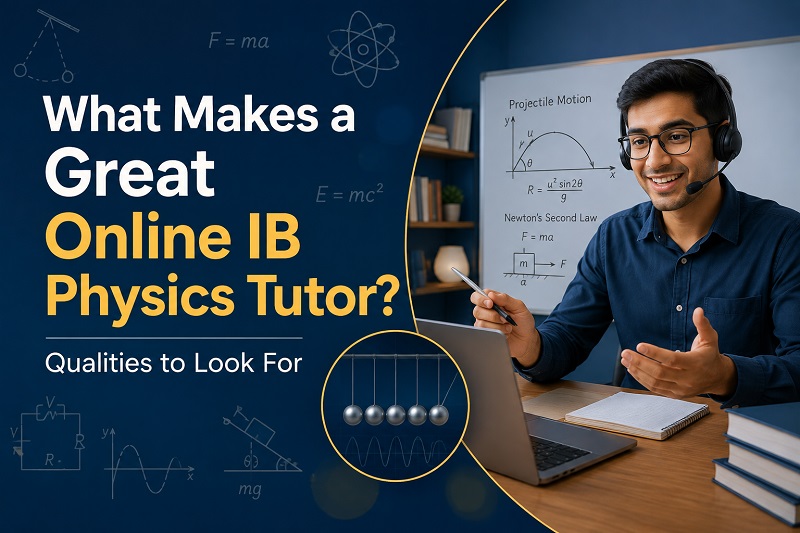
IB Physics is one of the most demanding subjects in the International Baccalaureate Diploma Programme. Between conceptual depth, mathematical rigor, the Internal Assessment (IA), and exam papers that test application over memorization, many students find that classroom instruction alone isn’t enough. This is where a great online IB Physics tutor makes the difference between struggling through the syllabus and genuinely mastering it.
But not all tutors are created equal. If you’re a student or parent searching for the right fit, here’s exactly what to look for — and why it matters.
Quick Answer: What Makes a Great Online IB Physics Tutor?
A great online IB Physics tutor combines deep subject mastery with IB-specific curriculum knowledge, strong teaching methodology, IA and Extended Essay guidance experience, adaptability to different learning styles, and reliable use of digital tools for interactive online learning. Platforms like Teaching Academy vet tutors on all these dimensions, which is why students consistently see measurable score improvements.
Below, we break down each quality in detail.
Deep Command of IB Physics Content — Not Just “Physics in General”
IB Physics isn’t the same as AP Physics, A-Level Physics, or a generic high school curriculum. It has its own syllabus structure, its own command terms (define, describe, explain, evaluate), its own data booklet, and its own assessment objectives (AO1–AO4).
A tutor who has only taught general physics may miss these nuances. A great online IB Physics tutor:
- Knows the current IB Physics syllabus (Standard Level and Higher Level) inside out, including the Additional Higher Level (AHL) topics
- Understands how IB structures Paper 1 (multiple choice), Paper 2 (data-based and extended response), and Paper 3 (option topics)
- Is fluent with the IB data booklet and how students are expected to use it under exam conditions
- Stays updated on syllabus changes, since the IB periodically revises content and assessment criteria
This is why Teaching Academy specifically trains and screens its Online IB Physics Tutors on the IB syllabus rather than treating physics tutoring as one-size-fits-all.
Ability to Teach for Both SL and HL — With Different Strategies
Standard Level and Higher Level IB Physics aren’t just “the same course with extra topics.” HL demands a different depth of mathematical treatment, more rigorous derivations, and faster problem-solving under time pressure.
A great tutor adjusts their approach:
- For SL students, the focus is often building conceptual clarity and confidence with core formulas
- For HL students, the focus shifts toward mathematical fluency, multi-step problem-solving, and connecting AHL topics like relativity or engineering physics to core concepts
If a tutor teaches HL and SL identically, that’s a red flag. Ask prospective tutors how their teaching style changes between the two levels — their answer will tell you a lot.
Strong Internal Assessment (IA) Guidance
The IB Physics Internal Assessment is where many students lose easy marks — not because they lack ability, but because they don’t understand what examiners are looking for in terms of research design, data processing, and evaluation of uncertainties.
A great online IB Physics tutor should be able to:
- Help students choose a feasible, original IA topic (not an overused one)
- Guide proper experimental design and variable control
- Teach correct treatment of uncertainties and error propagation
- Review draft write-ups against the official IA rubric (Personal Engagement, Exploration, Analysis, Evaluation, Communication)
This is a specialized skill separate from just “knowing physics,” which is why students specifically search for a tutor experienced in IA mentorship — a core offering under Teaching Academy’s Online IB Physics Tutor programs.
A Teaching Style That Builds Understanding, Not Just Answers
There’s a meaningful difference between a tutor who gives you the answer and one who teaches you how to think through the problem. IB Physics exams reward application and reasoning — Paper 2 and Paper 3 questions often present unfamiliar scenarios that require students to apply known principles in new contexts.
Look for a tutor who:
- Asks guiding questions instead of immediately solving problems for the student
- Encourages “first principles” thinking — starting from definitions and fundamental laws
- Uses real IB past paper questions to build exam technique, not just textbook problems
- Explains the “why” behind formulas, not just how to plug numbers in
This teaching philosophy is what separates a tutor who helps a student pass from one who helps a student genuinely excel.
Comfort and Skill with Online Teaching Tools
Online tutoring isn’t just an in-person lesson moved to a video call. It requires specific tools and techniques to replicate — and often improve on — the in-person experience.
A great online IB Physics tutor should be comfortable using:
- A digital whiteboard for real-time working of equations, diagrams, and graphs
- Screen sharing to walk through simulations, past paper solutions, or graphing software
- Recorded sessions so students can revisit explanations before exams
- Structured session notes and homework tracking so learning is continuous, not one-off
Tutors on platforms like Teaching Academy typically use dedicated online classrooms designed for STEM subjects, which allow smooth handling of diagrams, equations, and data — something a generic video call setup often struggles with.
Personalization Based on the Student’s Actual Weak Points
No two IB Physics students struggle with the same things. One student might be strong in mechanics but lost in electromagnetism. Another might understand concepts perfectly but lose marks on exam technique and time management.
A great tutor doesn’t run a fixed curriculum regardless of the student. Instead, they:
- Start with a diagnostic assessment to identify specific gaps
- Adjust pacing — spending more time on weak topics and moving faster through strong ones
- Track progress over time and adapt the plan as the student improves
- Communicate regularly with parents or the student on progress (where appropriate)
This kind of personalization is a defining feature of one-on-one tutoring done well, and it’s a standard practice for tutors matched through Teaching Academy’s Online IB Physics Tutor service.
Familiarity with Grade Boundaries and Assessment Criteria
Understanding how the IB actually awards marks is a skill in itself. A great tutor can explain:
- How grade boundaries are set for Physics SL and HL each session
- How marks are distributed across command terms in exam answers
- What separates a 5 from a 6, or a 6 from a 7, in typical student responses
- How to avoid common mark-losing habits, like skipping units or missing significant figures
This meta-knowledge of the assessment system — not just the content — is often what pushes a student from a good grade to a top grade.
Patience, Communication, and the Ability to Simplify Complex Ideas
Physics concepts like quantum mechanics, relativity, or electromagnetic induction can feel abstract and intimidating. A great tutor breaks these down using analogies, visualizations, and step-by-step logic rather than jargon-heavy explanations.
Equally important is soft skills:
- Patience with students who need concepts repeated in different ways
- Clear, jargon-free communication
- Encouragement that builds confidence rather than anxiety around a tough subject
- Responsiveness to questions between sessions when possible
Students learn best from tutors who make them feel comfortable asking “obvious” questions.
Track Record and Verified Results
Finally, look for evidence, not just claims. A great online IB Physics tutor — or the platform representing them — should be able to show:
- Verified improvement in student grades over a tutoring period
- Experience across multiple IB schools and curricula variations
- Reviews or testimonials from actual IB students and parents
- Transparent tutor qualifications (degree background, IB examiner experience, years of teaching)
This is where working with an established platform like Teaching Academy offers an advantage over hiring an independent tutor with no verification — tutors are screened, results are tracked, and accountability exists.
Frequently Asked Questions
How do I know if an online IB Physics tutor is qualified for HL specifically? Ask about their experience with AHL topics (like relativity, engineering physics, or astrophysics options) and request examples of how they’ve helped past HL students improve exam performance.
Can an online tutor really help with the IA as much as an in-person one? Yes — with screen sharing and digital annotation tools, tutors can review data tables, graphs, and write-ups in real time just as effectively as in person, often more efficiently since documents can be shared and edited live.
How soon can tutoring show results in IB Physics? It depends on the starting point and exam timeline, but most students see noticeable improvement in problem-solving speed and conceptual clarity within 4–6 weeks of consistent sessions.
Is one-on-one tutoring necessary, or do group sessions work too? Both have value. One-on-one tutoring is best for targeted weak-area correction and IA support, while group sessions can be useful for exam technique practice and peer discussion.
Choosing the right online IB Physics tutor isn’t about finding the cheapest or most convenient option — it’s about finding someone who understands the IB syllabus deeply, teaches for genuine understanding, supports IA and exam preparation specifically, and adapts to the individual student. Platforms like Teaching Academy are built around exactly these qualities, connecting students with vetted Online IB Physics Tutors who combine subject expertise with IB-specific teaching experience.
If you’re evaluating tutors, use the qualities above as a checklist — and don’t hesitate to ask direct questions before committing to a long-term tutoring relationship.