
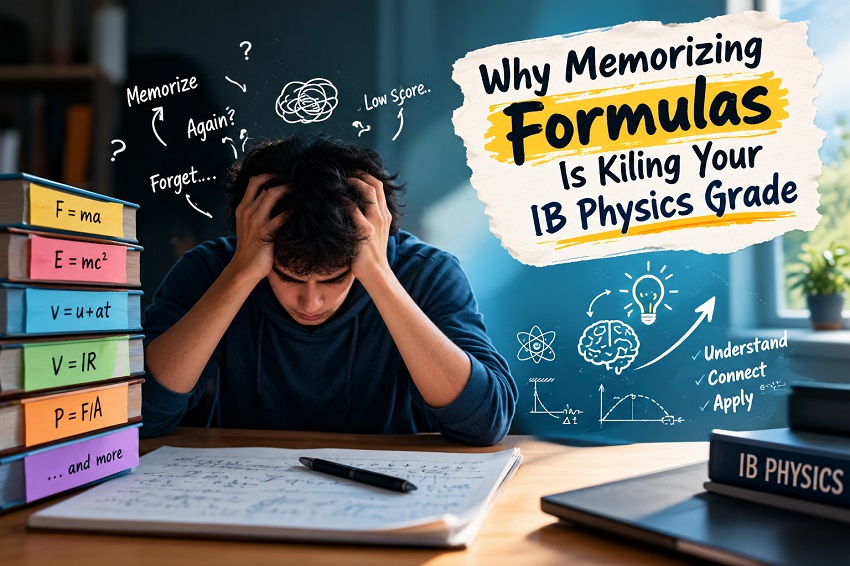
If you’ve spent hours memorizing every formula in your IB Physics data booklet and still walked out of your exam feeling shaky, you’re not alone — and you’re not doing anything wrong as a student. The problem isn’t you. It’s the strategy.
At Teaching Academy, we work with IB Physics students every year who come to us with the same story: “I know the formulas, but I can’t apply them.” This single sentence explains why so many hardworking students score a 4 or 5 instead of the 6 or 7 they’re capable of. In this blog, we’ll break down exactly why formula memorization backfires in IB Physics, what the IB actually tests, and how working with an Online IB Physics Tutor can help you shift from memorizing to mastering.
The Big Misconception: IB Physics Is Not a Memory Test
Many students treat IB Physics the way they’d treat a biology or history exam — cramming facts and formulas the night before, hoping recall will carry them through. But IB Physics, especially at Higher Level, is fundamentally a conceptual and analytical subject. The IB examiners design questions specifically to catch students who rely on memorization without understanding.
Here’s the truth: the IB gives you a data booklet with nearly every formula you need during the actual exam. So if the formulas are already provided, why do students who memorized them still lose marks?
Because knowing a formula and knowing when, why, and how to use it are two completely different skills.
Why Formula Memorization Fails in IB Physics
1. IB Questions Are Designed to Test Application, Not Recall
IB Physics exam questions — particularly Paper 2 and Paper 3 — rarely ask “What is the formula for X?” Instead, they present unfamiliar scenarios, multi-step problems, or real-world contexts that require you to identify which concept is being tested before you even think about which formula applies.
A student who has memorized formulas without understanding the underlying physics often freezes when the question doesn’t match the “textbook version” they practiced.
2. Physics Concepts Build on Each Other
IB Physics topics are deeply interconnected. Circular motion connects to gravitation. Simple harmonic motion connects to waves. Electricity connects to magnetism and eventually to electromagnetic induction. If you memorize formulas in isolation without understanding these connections, you’ll struggle the moment a question blends two topics — which happens constantly in Paper 2 and Paper 3.
3. Sig Figs, Units, and Derivations Punish Shallow Learning
Memorization-based learning often skips the “why” behind a formula. This leads to common, grade-killing mistakes:
- Using the wrong version of a formula for a given context
- Forgetting unit conversions because the reasoning wasn’t understood
- Struggling with derivation-based or “show that” questions
- Panicking when a formula isn’t explicitly given and must be derived
4. It Creates False Confidence
This is perhaps the most dangerous trap. Students who memorize feel prepared — until they sit the actual exam. That gap between perceived readiness and actual exam performance is one of the most common reasons predicted grades don’t match final IB scores.
What the IB Actually Rewards
The IB Physics syllabus is built around the Nature of Science and assessment objectives that prioritize:
- Understanding — explaining phenomena, not just stating facts
- Application — using concepts in unfamiliar, real-world situations
- Analysis — interpreting data, graphs, and experimental results
- Evaluation — assessing the validity of methods, models, and conclusions
Notice that “memorization” isn’t listed anywhere. The IB explicitly rewards students who can think like physicists, not students who can recite formulas the fastest.
How to Shift From Memorizing to Understanding
Learn the “Story” Behind Each Formula
Instead of memorizing that \(v = u + at\), understand what each variable represents physically and why the relationship exists. When you understand the logic, you can reconstruct or adapt the formula even if a question twists it.
Practice with Unfamiliar Questions
Past papers are useful, but real growth comes from applying concepts to questions you haven’t seen before. This mirrors exactly what the IB exam does.
Focus on Graphs, Data, and Real Experiments
IB Physics puts heavy weight on interpreting graphs and experimental data. Understanding why a graph looks a certain way is far more valuable than memorizing formulas related to it.
Connect Topics Instead of Studying Them in Isolation
Create concept maps linking mechanics, waves, electricity, and modern physics. The IB loves testing overlapping ideas, especially in Paper 3.
Get Personalized Feedback
This is where most students hit a wall studying alone. You don’t know what you don’t understand — and that’s exactly where a tutor becomes valuable.
How an Online IB Physics Tutor Makes the Difference
Working with an Online IB Physics Tutor through Teaching Academy isn’t about re-teaching formulas you already have written down. It’s about building true conceptual fluency so you can walk into any exam scenario with confidence, not guesswork.
Here’s how Teaching Academy’s approach is different:
1. Concept-First Teaching Our tutors break down the “why” behind every formula so students understand the physics, not just the math.
2. Exam-Style Problem Solving We train students on IB-style application questions from Paper 1, 2, and 3 — the exact question formats that trip up memorization-based learners.
3. Personalized 1-on-1 Sessions Every student has different gaps. Our online tutors identify exactly where conceptual misunderstandings exist and correct them early, before they compound.
4. IA and Extended Essay Support Physics Internal Assessments require genuine understanding of experimental design, uncertainty, and data analysis — areas where memorization offers zero help.
5. Flexible, Global Access As an online-first academy, Teaching Academy connects IB students worldwide with expert physics tutors, regardless of time zone or curriculum board (IB, IGCSE, or A-Level).
Frequently Asked Questions
Q: Is memorizing formulas completely useless for IB Physics? No — familiarity helps with speed, but memorization alone won’t help you solve unfamiliar or multi-step problems, which make up most of the exam.
Q: Why do I still lose marks even when I use the right formula? Common reasons include misapplying the formula’s assumptions, ignoring units, missing sig figs, or misunderstanding the physical context of the question.
Q: How can an online tutor help more than self-study? A tutor identifies conceptual gaps in real time, something self-study often misses until exam day.
Q: What’s the fastest way to improve IB Physics application skills? Practice unfamiliar problems regularly, understand derivations, and get structured feedback — ideally through consistent 1-on-1 tutoring.
If you’ve been grinding through formula sheets and still feel unprepared, it’s not a sign that you need to memorize harder — it’s a sign you need to understand deeper. IB Physics rewards conceptual clarity, critical thinking, and the ability to apply knowledge in new situations.
At Teaching Academy, our Online IB Physics Tutor programs are designed to help students break free from the memorization trap and build the kind of understanding that leads to consistently higher grades — not just short-term exam survival.
Ready to stop memorizing and start truly understanding IB Physics? Connect with Teaching Academy’s expert IB Physics tutors today and turn your weakest topics into your strongest scores.